How Diffusion Controller unifies and simplifies AI image generation
Google Research introduces Diffusion Controller, a lightweight steering network that improves prompt alignment in text-to-image models. The framework reframes denoising as a continuous control problem, allowing attachment to closed-source models without fine-tuning. The blog reports it outperforms industry standards for human preference matching, though independent verification of these performance claims is not yet available.
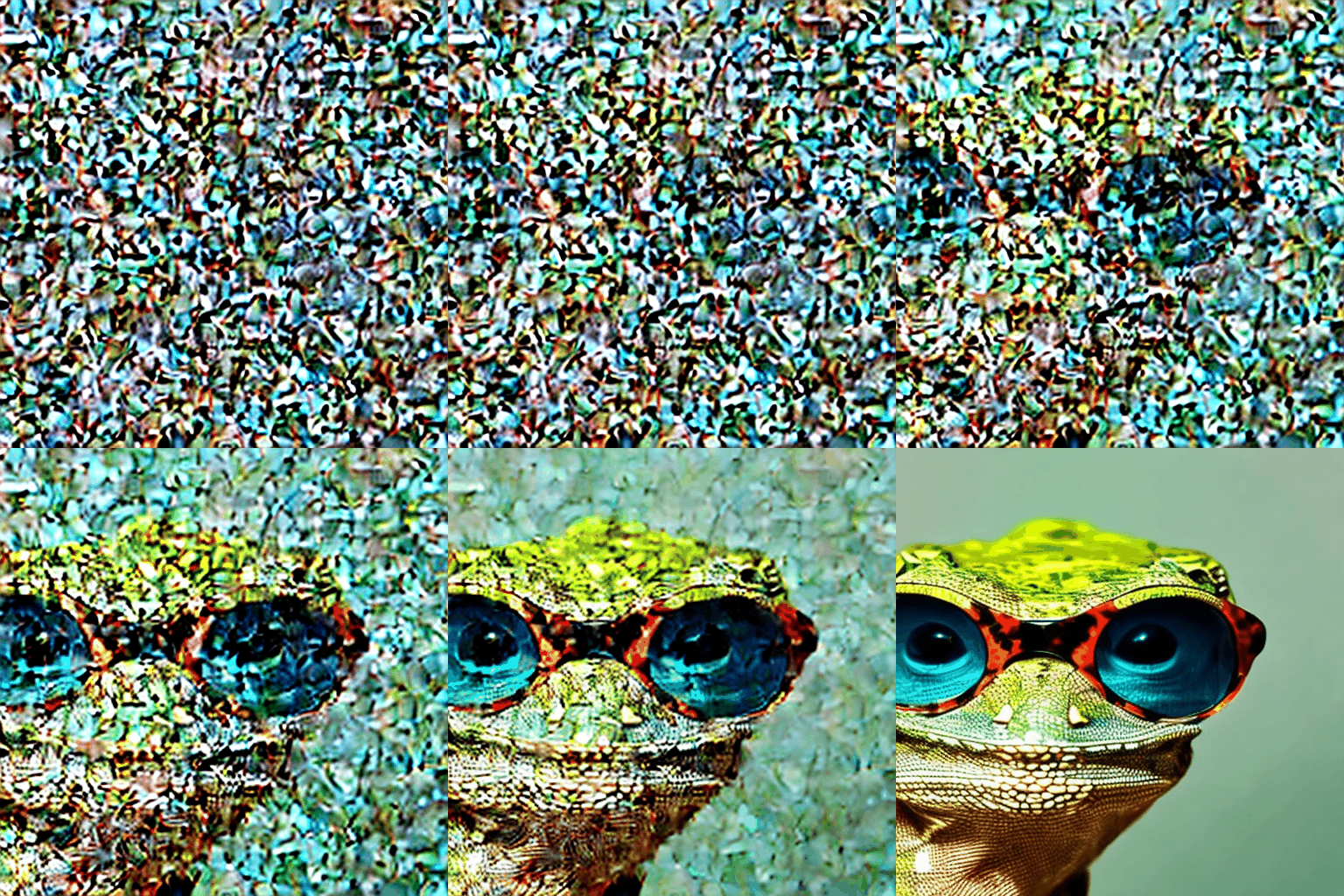
Diffusion Controller is a lightweight “steering damper” that attaches to existing text‑to‑image models and improves how closely the output follows a user’s prompt. According to the authors, the fully unlocked version of the system achieved a 90 % win rate when compared with the baseline model, and the lightweight add‑on outperformed the current industry standard for matching human preferences. The claim comes from the Google Research team that introduced the method. The performance numbers were derived from experiments that compared generated images against human‑rated preferences, using a final reward score to guide the optimization. Two training approaches were employed: a policy‑gradient method with a clipping rule and a reward‑weighted loss that directly maximizes the reward. The win‑rate figure reflects the proportion of test cases where the Diffusion Controller’s output was preferred over the baseline. The report does not include independent verification of the preference‑matching claims, so the extent to which the results generalize beyond the authors’ tests remains uncertain. It also does not provide detailed statistics on image quality metrics such as fidelity or diversity, nor does it reveal how the system performs on prompts that differ substantially from those used in the study.